

How BIOS/UEFI Is Evolving in Server Motherboards for Remote Management
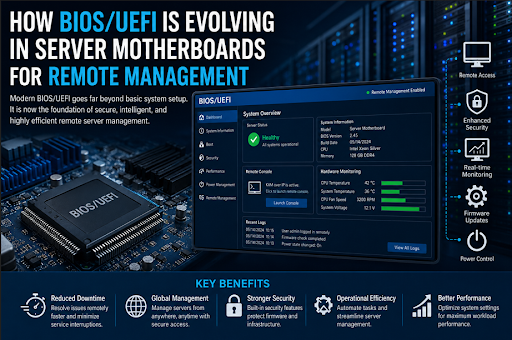
Managing servers used to mean walking into a noisy data center, plugging in a monitor, and manually fixing hardware issues one machine at a time. Today, that approach feels outdated. Modern businesses expect their IT teams to manage entire server environments remotely, often across multiple cities or even continents. As a result, server hardware has changed dramatically, especially at the firmware level.
One of the biggest transformations is happening inside BIOS/UEFI technology. What was once a basic startup interface has evolved into a smart management layer that helps administrators monitor, secure, recover, and control servers from virtually anywhere. For companies planning infrastructure upgrades or looking to Buy Server Motherboards, understanding these firmware advancements is becoming increasingly important because remote management capabilities now directly affect uptime, security, and operational efficiency.
Modern server motherboards are no longer just platforms for CPUs and memory. They are intelligent systems designed to support automation, remote access, predictive monitoring, and enterprise-level security. Firmware plays a central role in making all of this possible.
The Evolution of BIOS/UEFI in Enterprise Servers
In the early days of computing, firmware existed mainly to initialize hardware and start the operating system. Traditional BIOS systems were functional, but they offered limited flexibility and almost no remote capabilities. Administrators had to physically access servers whenever configuration changes or troubleshooting were needed.
That changed when UEFI entered the market. Unlike legacy BIOS, UEFI introduced a more advanced architecture with faster boot speeds, larger storage support, graphical interfaces, and improved hardware communication. More importantly, it created opportunities for intelligent remote management features that modern enterprises now rely on daily.
Today’s BIOS/UEFI environments can integrate directly with management controllers, cloud dashboards, and enterprise automation platforms. This means administrators can configure hardware settings, deploy updates, or recover systems remotely without needing physical access to the server room.
The difference is enormous. Instead of sending technicians onsite for routine maintenance, organizations can now handle many tasks from a central management console. This saves time, reduces costs, and minimizes downtime during critical situations.
Why Remote Management Has Become Essential
Businesses are operating in a very different world compared to a decade ago. Infrastructure is no longer centralized in a single office or data center. Companies now run workloads across branch offices, colocation facilities, hybrid clouds, and edge environments.
Because of this shift, remote server management is no longer optional. It has become a core requirement for maintaining business continuity.
Modern server firmware supports features that allow IT teams to:
- Monitor hardware health remotely
- Restart frozen systems
- Install operating systems over the network
- Manage power settings
- Update firmware from remote locations
- Configure RAID and boot settings
- Troubleshoot failed hardware
Access servers even when the operating system crashes
These capabilities are especially valuable for organizations with limited onsite technical staff. A server located hundreds of miles away can often be repaired remotely within minutes instead of waiting hours for physical intervention.
This operational flexibility is one of the main reasons enterprise firmware continues evolving so rapidly.
How BIOS/UEFI Works With Remote Management Controllers
One of the most important innovations in modern server architecture is the integration between BIOS/UEFI and Baseboard Management Controllers, commonly called BMCs.
A BMC is essentially a dedicated processor embedded on the server motherboard. It operates independently from the main CPU and operating system, allowing administrators to manage the server even when the system is powered off or unresponsive.
This integration creates powerful remote management capabilities. Administrators can open a secure web interface and interact with the server almost as if they were physically sitting in front of it.
For example, they can:
- Change boot priorities
- Enable virtualization settings
- Monitor CPU temperatures
- View hardware logs
- Control cooling systems
- Launch remote recovery tools
- Mount virtual installation media
- Access pre boot environments
What makes this even more impressive is that these actions can happen regardless of the operating system state. Even if Windows, Linux, or a hypervisor fails completely, administrators can still interact with the server through firmware level controls.
That level of access is critical in modern enterprise environments where uptime directly impacts revenue and customer experience.
Security Is Now a Major Firmware Priority
As remote capabilities expand, firmware security has become one of the most important concerns in enterprise computing.
Cybercriminals increasingly target firmware because attacks at this level are difficult to detect. If attackers compromise firmware, they may maintain access even after the operating system is reinstalled.
This has pushed motherboard manufacturers to rethink how firmware security is designed.
Modern BIOS/UEFI implementations now include advanced protections such as:
Secure Boot
- Firmware validation
- Cryptographic signing
- Trusted Platform Module integration
- Runtime integrity checks
- Hardware root of trust
- Rollback protection
- Measured boot verification
These technologies help ensure that only trusted firmware and operating systems are allowed to run on enterprise servers.
In addition, many server vendors now provide automated firmware monitoring tools that alert administrators if suspicious changes occur. This proactive approach helps organizations respond to threats before they become serious security incidents.
Firmware updates themselves have also become more secure. Earlier systems often carried the risk of failed updates that could permanently damage servers. Modern enterprise platforms use redundant firmware images and automated recovery mechanisms to reduce that risk significantly.
Cloud Connected Management Is Changing Everything
Another major trend shaping server firmware is cloud based infrastructure management.
Traditionally, server administration tools worked only within local networks. However, businesses now require centralized visibility across globally distributed systems. As a result, many modern server motherboards are designed to integrate directly with cloud management platforms.
This allows IT teams to:
- Track hardware health across multiple locations
- Automate firmware deployment
- Monitor energy usage
- Enforce security policies
- Receive predictive maintenance alerts
- Manage configurations at scale
The ability to manage infrastructure centrally has transformed how organizations handle server operations. Instead of logging into individual machines one at a time, administrators can now apply policies across entire fleets of servers simultaneously.
This becomes especially important for large enterprises managing thousands of systems across different regions.
Cloud integration also supports faster scalability. New servers can often be provisioned automatically with predefined settings the moment they are connected to the network.
BIOS/UEFI and the Rise of Automation
Automation is becoming a defining feature of modern data centers, and firmware plays a surprisingly important role in that transformation.
Today’s enterprise environments rely heavily on automation tools to deploy workloads, maintain consistency, and reduce manual errors. Server firmware is evolving to support these goals through programmable interfaces and policy driven management.
For example, administrators can automate:
- Firmware updates
- Power management adjustments
- Boot sequence configuration
- Hardware health monitoring
- Recovery procedures
- Security compliance checks
This level of automation dramatically improves operational efficiency while reducing the workload placed on IT teams.
Instead of spending hours manually configuring servers, organizations can deploy standardized settings automatically across hundreds of systems.
As artificial intelligence and machine learning continue advancing, firmware level automation will likely become even smarter. Future systems may detect hardware anomalies and initiate corrective actions automatically before users notice any issues.
Energy Efficiency Is Driving Firmware Innovation
Power consumption has become a major concern for modern data centers. Large server environments consume enormous amounts of electricity, making efficiency a top priority for businesses focused on operational costs and sustainability.
Modern BIOS/UEFI platforms now include intelligent power management features that optimize server performance while reducing unnecessary energy usage.
These systems can dynamically:
- Adjust processor power states
- Control cooling behavior
- Balance thermal performance
- Reduce idle power consumption
- Optimize fan speeds
- Monitor power distribution
Remote management tools make these capabilities even more useful by allowing administrators to track energy usage trends across multiple facilities.
For companies operating large scale infrastructure, even small improvements in efficiency can lead to substantial long term savings.
Headless Infrastructure Is Becoming the Standard
Many modern servers no longer include dedicated monitors or local input devices. These “headless” systems are designed to operate entirely through remote management interfaces.
This trend has accelerated the demand for advanced firmware capabilities.
Administrators now expect to access full remote console environments that allow them to interact with servers during every stage of operation, including the boot process itself.
Modern server motherboards support remote KVM functionality, giving administrators visual access to firmware menus and recovery tools from virtually anywhere.
This is particularly useful during:
- Operating system failures
- Firmware corruption
- Hardware diagnostics
- Storage initialization
- Virtualization setup
- Security policy enforcement
Without these capabilities, troubleshooting remote systems would become significantly more difficult and time consuming.
Open Standards Are Improving Compatibility
Another important change in the server industry is the movement toward open management standards.
Older enterprise environments often relied on proprietary tools that created compatibility issues between different hardware vendors. Today, many organizations prefer open standards that simplify large scale infrastructure management.
Technologies like Redfish are helping standardize how firmware communicates with remote management software. This improves interoperability and allows businesses to manage mixed hardware environments more efficiently.
Open standards also encourage innovation by making it easier for software developers to create management tools that work across multiple server platforms.
As enterprise infrastructure becomes more complex, this level of compatibility will continue growing in importance.
The Future of BIOS/UEFI in Server Technology
The future of server firmware is moving toward greater intelligence, automation, and resilience.
In the coming years, BIOS/UEFI platforms will likely become even more integrated with artificial intelligence driven management systems. Servers may eventually diagnose hardware issues, optimize performance settings, and recover from failures automatically with minimal human involvement.
Future developments could include:
- Self healing firmware
- AI driven diagnostics
- Autonomous performance tuning
- Advanced threat detection
- Real time firmware analytics
- Smarter energy optimization
- Enhanced edge computing support
As organizations continue adopting hybrid cloud and edge infrastructure, remote management capabilities will become even more critical.
Firmware will no longer be viewed as a background component hidden behind the operating system. Instead, it will serve as one of the most strategic layers of enterprise infrastructure management.
Conclusion
The role of firmware in enterprise servers has changed dramatically over the last decade. What once functioned as a simple startup mechanism has evolved into an intelligent platform that supports remote management, automation, security, and operational efficiency.
Modern BIOS/UEFI technology now enables administrators to manage servers remotely, recover failed systems, monitor hardware health, and secure infrastructure against increasingly sophisticated threats. These capabilities are helping businesses reduce downtime, improve scalability, and streamline IT operations across distributed environments.
As server environments continue becoming more connected and automated, firmware innovation will remain at the center of enterprise infrastructure strategy. Organizations investing in modern server motherboards should pay close attention to firmware capabilities because they now play a direct role in reliability, performance, and long term business continuity.
The future of enterprise computing is not just about faster hardware. It is about smarter infrastructure management, and firmware is leading that transformation.