


CMS’s 2030 VBC Goal and What It Requires From Provider Organizations Starting Now
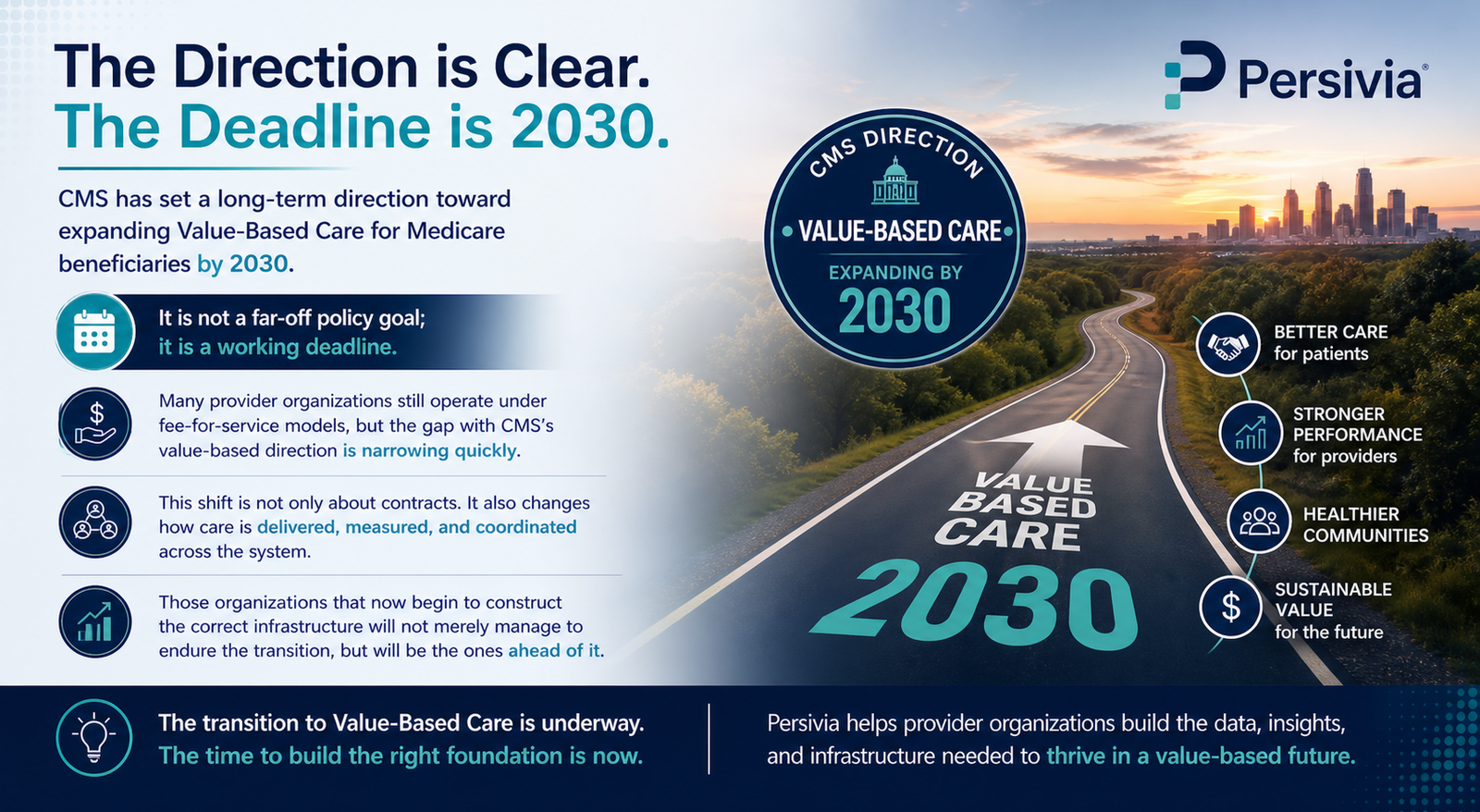
CMS has set a long-term direction toward expanding Value-Based Care for Medicare beneficiaries by 2030. It is not a far-off policy goal; it is a working deadline. Many provider organizations still operate under fee-for-service models, but the gap with CMS’s value-based direction is narrowing quickly.
This shift is not only about contracts. It also changes how care is delivered, measured, and coordinated across the system. Those organizations that now begin to construct the correct infrastructure will not merely manage to endure the transition, but will be the ones ahead of it.
What the 2030 Goal Actually Demands
CMS has been increasing value-based models over the years, such as MSSP, ACO REACH, TEAM, and LEAD, but the 2030 target brings them all under a single banner: outcomes over volume. This alters the payment methods of providers, their performance measurement, and patient population management.
The Core Shift in Accountability
In this model, providers are no longer evaluated only on individual visits. They are responsible for what happens before it, during it, and after it.
- Payments tied to quality outcomes
- The total cost of care falls under provider accountability
- Reimbursement is directly related to the readmission rates, chronic disease control, and preventive screenings.
- The importance of care coordination in settings turns into a financial priority rather than a clinical one.
Data Infrastructure: The Foundation Everything Else Sits On
Any strategy of Value-Based Care cannot operate without a full, real-time picture of the patient population. The vast majority of organizations have their data distributed across EHRs, labs, claims, referrals, and care notes without a single view.
What Needs to Be in Place
Aggregating data into a single longitudinal patient record is essential. Without it, risk stratification becomes unreliable, care gaps remain hidden, and quality reporting becomes fragmented.
- Connect EHR, claims, labs, and social determinants in one place
- Create AI-based analytics that can identify high-risk patients before they reach the emergency department.
- Ensure every care team member works from the same real-time data, no version gaps, no siloed views.
Care Management: Moving From Reactive to Proactive
Fee-for-service rewards treating illness. Value-Based Care rewards prevent it. That distinction has to be built into care operations.
Closing Gaps Before They Become Costs
- Identify high-risk and rising-risk patients using predictive scoring
- Assign care managers to patients most likely to generate avoidable utilization.
- Coordinate transitions from hospital to home, specialist to PCP, to cut readmissions.
- Close gaps in care on preventive screenings and chronic disease follow-ups preceding quality reporting windows.
Quality and Risk Adjustment: Where Performance Gets Scored
Quality measurement and risk adjustment are where value-based contracts are won or lost. Organizations that track metrics in real time can fix problems mid-year. Those reviewing performance quarterly often find out too late to course-correct.
Risk Adjustment Cannot Be an Afterthought
Incomplete HCC coding means taking on more patient complexity than you’re being compensated for. A strong value-based care solution catches those gaps at the point of care.
- Reconcile clinical documentation against claims data regularly
- Use AI to flag coding gaps before submission windows close
- Ensure risk scores reflect the true complexity of your patient panel
Provider and Patient Engagement: The Layer That Makes It Real
Technology only creates impact when it is actively used by providers and care teams. Providers should receive clear and practical alerts on the visit, rather than 40-page reports. Patients require outreach that is timely, relevant, and easy to take action on.
- Point-of-care tools that surface care gaps and risk flags in real time
- Performance dashboards so physicians know where they stand (not where they stood last quarter)
- Patient outreach through multiple channels, text, call, and portal, based on individual preference
- Messaging that is clear enough to influence patient behavior
What Early Adopters Are Achieving in Value-Based Care
Organizations that moved early are already posting results. A 45-hospital health system across 14 states reported $17M in savings under CMS programs and received recognition for health equity outcomes. A 14-hospital network managing 4,400+ providers reached $34M in MSSP ACO savings in a single year, implemented in 60 days. A multi-facility organization with 400,000 patients and six VBC contracts hit a 100% efficiency increase within 90 days.
These outcomes share one common thread: the right platform behind the strategy.
Final Thoughts
The 2030 deadline is not something to prepare for later. The infrastructure decisions made right now, on how data gets unified, how care gaps get closed, and how risk gets captured, determine whether that deadline is a challenge already solved or one being scrambled toward. Provider organizations that act early are likely to gain a meaningful operational advantage over those that delay.
See What’s Possible With Persivia
Persivia’s CareSpace® brings together everything a provider organization needs for value-based success: unified patient records, AI-driven care management, real-time quality tracking, risk adjustment, and patient engagement, all on one platform, with no third parties involved. Implementations can go live in weeks, supporting providers, ACOs, and health systems in advancing value-based care performance.