

Voice AI Agents: How They Work, Benefits, Use Cases and Business Applications
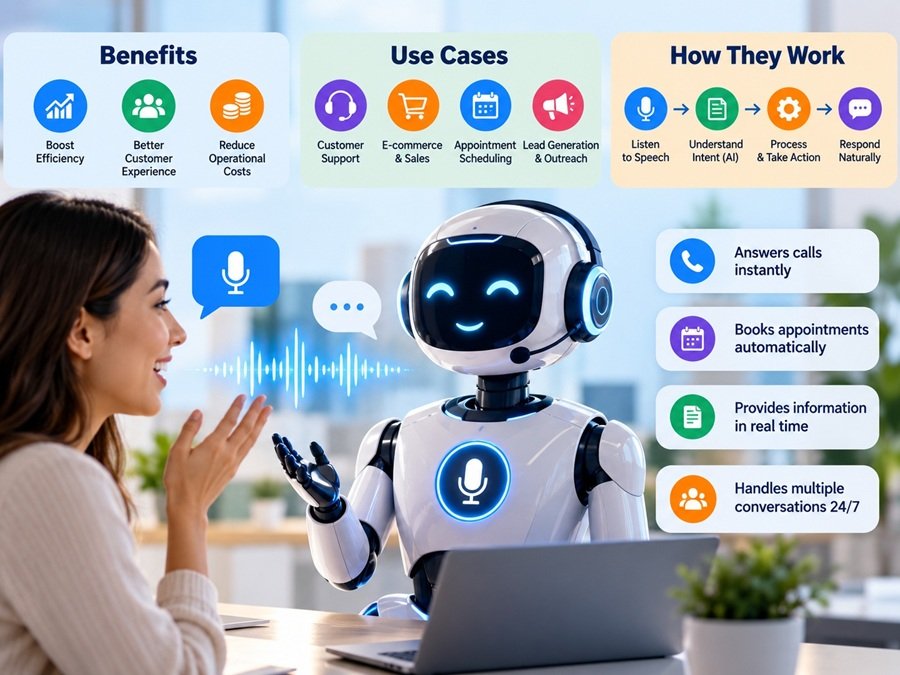
Voice AI agents are AI-powered systems that understand spoken language, respond naturally in real time and perform tasks through connected business applications. Unlike traditional automated phone systems that rely heavily on fixed menus, modern voice AI agents can interpret customer intent, maintain conversational context and help complete tasks such as appointment scheduling, order tracking and customer support.
As businesses look for ways to improve customer experience while managing growing service volumes, voice AI agents are becoming an important part of enterprise automation. They can support contact centres, automate repetitive conversations and help customers access information without waiting for a human representative.
What Are Voice AI Agents?
Voice AI agents are intelligent software systems that use artificial intelligence to communicate with people through spoken conversations. They combine speech processing, language understanding, conversational reasoning and, where permitted, integrations with business applications to respond to requests and perform actions.
A basic voice assistant might answer a frequently asked question or provide information about a service. A more capable voice AI agent can understand a multi-step request, retrieve relevant information, follow an approved workflow and confirm the outcome to the customer.
For example, a customer calling an airline could ask to change a booking. A voice AI agent may identify the customer’s intent, retrieve booking details through an authorised system, check the available options and guide the customer through the permitted changes.
The exact capabilities depend on the AI model, integrations, business rules and level of access configured for the agent.
How Do Voice AI Agents Work?
Voice AI agents combine several technologies to support natural, task-oriented conversations.
1. Speech recognition and understanding
The system processes incoming speech to identify the customer’s words, intent and relevant details. Modern architectures may use different combinations of speech recognition and language understanding, depending on the application.
2. Conversational reasoning
The AI interprets the request in context and determines an appropriate response or next step. It can use information from earlier turns in the conversation to reduce the need for customers to repeat themselves.
3. Business system integration
When a request requires an action, the agent can use authorised APIs or connected applications to retrieve information or initiate a workflow. Depending on its permissions, this could include checking an order status, scheduling an appointment or creating a support ticket.
4. Voice response generation
The system generates a spoken response that communicates the answer or explains what happens next. Speech-to-speech architectures can process audio and generate audio responses more directly, potentially reducing the delays and information loss associated with some multi-stage pipelines.
5. Monitoring and escalation
Business rules and operational controls determine when the AI can proceed, when it needs confirmation and when a human employee should take over. Monitoring helps organisations assess response quality, task completion and customer experience.
Together, these capabilities enable voice AI agents to do more than respond to individual questions. They can support complete customer interactions, provided the required systems and permissions are in place.
Key Benefits of Voice AI Agents for Businesses
Voice AI agents can help enterprises improve service delivery and automate repetitive work. The results depend on the use case, integration quality, conversation design and operational controls.
1. 24/7 Customer Support
Traditional contact centres may need additional staff or outsourced coverage to handle enquiries outside normal business hours. Voice AI agents can provide automated assistance around the clock for supported tasks.
Customers can check service information, request updates, book appointments or receive answers to common questions without waiting for an employee to become available.
2. Faster Customer Interactions
Customers often contact support teams for straightforward requests that require retrieving information or completing a routine transaction. Voice AI agents can automate parts of these interactions and reduce unnecessary transfers between departments.
When integrated with the relevant systems, they can retrieve information and guide customers through the next step within the same conversation.
3. Improved Operational Efficiency
Contact centre employees frequently spend time answering repetitive questions, recording details and performing standard administrative tasks. Automating suitable interactions allows teams to focus more attention on complex complaints, sensitive situations and requests that require human judgement.
Businesses should measure the effect using metrics such as average handling time, first-contact resolution, escalation rates and cost per successfully completed interaction.
4. Scalable Customer Engagement
Customer service demand can change significantly during seasonal peaks, product launches or unexpected service disruptions. Voice AI agents can help handle additional routine interactions without requiring every conversation to be managed by a human employee.
However, scaling still requires sufficient infrastructure, reliable integrations, appropriate concurrency capacity and a plan for transferring complex cases to human teams.
5. More Consistent Customer Experiences
Human representatives may explain policies differently or overlook steps during busy periods. Properly configured voice AI agents can follow approved processes and deliver consistent information across supported interactions.
Organisations must keep knowledge sources, policies and workflows updated to avoid repeating outdated or incorrect information.
6. Multilingual Customer Engagement
Businesses operating across regions may need to support customers who speak different languages or switch between languages during a conversation. Multilingual voice AI can make automated services accessible to a wider audience when the relevant languages, accents and terminology are adequately supported.
Language support should be evaluated using real customer conversations rather than relying only on a platform’s advertised language count.
Top Voice AI Agent Use Cases Across Industries
Voice AI agents can support a wide range of customer-facing and operational workflows. The most suitable applications are usually frequent, well-defined and connected to reliable business data.

Customer service and contact centres
Voice AI agents can answer common enquiries, provide account or service information, route calls and collect details before transferring complex cases to human representatives. They can also support automated follow-ups and routine service requests.

Banking, financial services and insurance
Potential applications include payment reminders, policy information, application-status updates and appointment scheduling. Sensitive operations require strong identity verification, data protection and compliance controls.

Healthcare
Voice AI can help schedule appointments, send reminders, answer administrative questions and provide information about hospital services. Clinical decisions and urgent medical situations require appropriate safeguards and escalation procedures.

Retail and e-commerce
Retailers can use voice AI agents to provide order updates, explain return policies, answer product questions and support post-purchase enquiries. Connected systems allow agents to retrieve current information rather than relying on static responses.

Travel and hospitality
Voice AI agents can assist with booking enquiries, reservation changes, itinerary information and hotel service requests. Integration with booking systems is essential when an interaction involves live availability or a confirmed transaction.

Automotive and mobility
Businesses can automate service appointment bookings, maintenance reminders, test-drive enquiries and routine vehicle-service questions. Requests involving repairs, warranties or roadside emergencies may need human support.
Voice AI Agents vs Traditional IVR Systems
Interactive voice response (IVR) systems have long been used to route incoming calls and provide basic self-service. Voice AI agents expand these capabilities by enabling more flexible conversations and, when integrated with enterprise systems, task execution.
| Feature | Traditional IVR | Voice AI agents |
|---|---|---|
| Interaction style | Fixed menus and keypad choices | Natural spoken conversations |
| Understanding | Menu selections and configured rules | Natural-language intent, within system capabilities |
| Context | Often limited | Can retain conversational context |
| Task execution | Usually predefined workflows | Can execute authorised actions through integrations |
| Handling unexpected requests | Often redirects or repeats menus | May interpret requests or escalate |
| Personalisation | Typically rule-based | Can use authorised customer and session context |
| Implementation | Often simpler for basic routing | Requires AI configuration, testing and governance |
| Best suited for | Call routing and simple menu-based services | Dynamic enquiries and task-oriented interactions |
Traditional IVR remains useful for predictable call routing and straightforward menu-based processes. Voice AI agents are worth considering when customers need to explain requests in their own words or complete more complex interactions.
Many organisations can combine both approaches instead of replacing every existing telephony component.
Voice AI Agents vs AI Virtual Assistants
Although the terms are sometimes used interchangeably, voice AI agents and AI virtual assistants are not always the same.
An AI virtual assistant is a broad category of software that helps users obtain information or complete tasks through text, voice or other interfaces. A voice AI agent specifically uses spoken conversation as an interface and may have capabilities to pursue a goal or execute a workflow.
| Comparison | AI virtual assistant | Voice AI agent |
|---|---|---|
| Primary purpose | Provide assistance and automate tasks | Manage spoken interactions and achieve defined outcomes |
| Interface | Text, voice or multiple channels | Primarily voice, sometimes integrated with other channels |
| Conversation style | Can be simple or context-aware | Designed for real-time spoken interaction |
| Actions | Depends on available integrations | Can execute authorised actions when equipped to do so |
| Common examples | Website assistant, productivity assistant | Automated support agent, booking agent, outbound engagement agent |
The distinction is not absolute. An advanced virtual assistant may include voice interaction and task execution, while a voice AI agent may support only a narrow set of approved actions. The architecture and actual capabilities matter more than the product label.
What Should Businesses Look for in a Voice AI Agent Platform?
Selecting a voice AI agent platform requires more than comparing voice quality or the number of supported languages. Enterprises should assess how reliably the system handles conversations, connects to existing applications and operates within business policies.
Real-Time Responsiveness
Voice conversations require timely responses. Long pauses can make an automated interaction feel unnatural and cause customers to interrupt or abandon the call. Evaluate end-to-end latency, interruption handling and performance under realistic traffic conditions.
Enterprise Integrations
The platform should connect to the systems needed for the intended workflow, such as CRM, ERP, ticketing, booking or customer-data platforms. Integration testing should verify that the agent retrieves accurate information and performs only authorised actions.
Security and Data Privacy
Voice interactions can involve personal information, financial details and confidential business data. Enterprises should assess authentication, access controls, encryption, data retention, consent requirements and applicable regulatory obligations.
Human Handoffs
Not every conversation should be automated. The platform should recognise when a request falls outside its capabilities, when a customer asks for a human or when a sensitive situation requires escalation. The receiving employee should get relevant context wherever possible.
Analytics and Performance Monitoring
Businesses should monitor task-completion rates, response accuracy, customer satisfaction, escalation frequency, latency and operating costs. These metrics help identify problems and determine whether the deployment is delivering measurable value.
Multilingual and Omnichannel Capabilities
For global organisations, language support and continuity across channels can be important selection criteria. Evaluate how the system handles regional accents, mixed-language speech and transitions between voice, messaging and human support.
How to Implement Voice AI Agents Successfully
A structured rollout helps businesses manage implementation risks and demonstrate value before expanding automation across the organisation.
Step 1: Identify a suitable use case. Start with a high-volume, repeatable process, such as appointment scheduling, order-status enquiries or routine customer support.
Step 2: Map the customer journey. Document the questions customers ask, information the agent needs, actions it must perform and situations that require human intervention.
Step 3: Connect the necessary systems. Integrate the agent with approved data sources and business applications. Define its access permissions and establish validation rules for sensitive transactions.
Step 4: Test realistic conversations. Evaluate accents, background noise, interruptions, ambiguous requests, incorrect information, failed integrations and unexpected customer responses.
Step 5: Launch a controlled pilot. Deploy the agent for a limited workflow or customer segment. Compare its results with existing operations and collect feedback from customers and employees.
Step 6: Measure and improve. Review performance metrics, correct recurring issues and expand the deployment only when the system meets the required service, security and quality standards.
The objective should be reliable task completion, not simply increasing the percentage of calls handled by AI.
How Tata Communications Supports Voice AI for Enterprise Customer Experience
Tata Communications provides enterprise communications and digital infrastructure capabilities, including voice AI solutions designed to support more natural and automated customer interactions.
Its Kaleyra™ Voice AI offering and newer Commotion Voice AI platform content focus on real-time conversational experiences, multilingual interactions and the use of AI to support customer engagement workflows.
For enterprises considering voice AI agents, relevant capabilities include:
-
Real-time voice conversations: Support spoken interactions designed to feel more natural than fixed-menu phone systems.
-
Multilingual engagement: Help businesses serve customers across supported languages.
-
Workflow integration: Connect conversational interactions with business processes and systems, where configured.
-
Customer engagement automation: Support use cases such as appointment bookings, lead qualification, renewals and customer service.
-
Connected customer journeys: Bring voice interactions into broader customer experience workflows.
The right implementation depends on the business’s existing technology stack, the complexity of its customer journeys and the level of automation required.
Enterprises should assess the platform against their own performance, integration, security and governance requirements before deployment.
To explore the available capabilities, visit the relevant Tata Communications Voice AI solution page.
Frequently Asked Questions About Voice AI Agents
What is a voice AI agent?
A voice AI agent is an AI-powered system that understands spoken requests, responds conversationally and can perform authorised tasks through connected business applications. Common applications include customer support, appointment scheduling, order tracking and automated call handling.
How do voice AI agents work?
Voice AI agents process speech, interpret user intent, maintain relevant conversational context and generate spoken responses. When connected to business systems, they can retrieve information or execute approved workflows, with human escalation when required.
What is the difference between voice AI agents and voice assistants?
Voice assistants generally help users obtain information or perform tasks through voice or other interfaces. Voice AI agents focus on managing conversational interactions and achieving defined goals. However, advanced voice assistants may offer many of the same agent capabilities.
Can voice AI agents replace human customer service representatives?
Voice AI agents can automate routine enquiries and repetitive workflows, but they cannot reliably replace human judgement in every situation. Complex complaints, sensitive conversations, unusual requests and decisions requiring human accountability may still need employee involvement.
Are voice AI agents suitable for enterprise contact centres?
Yes. They can support inbound enquiries, outbound engagement, call routing, appointment scheduling and other repeatable customer interactions. Suitability depends on integration capabilities, service quality, security controls and the complexity of the contact centre’s workflows.
Do voice AI agents support multiple languages?
Many platforms support multiple languages, but actual coverage varies. Businesses should test the languages, accents, terminology and code-switching patterns relevant to their customers before choosing a solution.
How can businesses measure the ROI of voice AI agents?
Businesses can evaluate return on investment by comparing implementation and operating costs against measurable outcomes. Relevant metrics include cost per resolved interaction, average handling time, first-contact resolution, customer satisfaction, successful task completion and reduced manual workload.
Are voice AI agents secure?
They can be deployed with security controls such as authentication, encryption, role-based access, audit logging and data-retention policies. Security depends on the platform, integrations, configuration and the organisation’s governance practices.
Conclusion
Voice AI agents are changing how businesses handle spoken customer interactions by combining conversational AI with workflow automation. They can help enterprises provide faster support, automate repetitive tasks, scale customer engagement and connect conversations with business systems.
Successful adoption requires more than natural-sounding speech. Organisations must prioritise reliable integrations, data security, measurable outcomes and smooth escalation to human employees.
For enterprises evaluating voice AI agents, the practical starting point is to identify one well-defined customer journey, test the technology against real operating conditions and expand automation based on measurable results.