

How to Calculate Car Mileage: Formula, Examples & Tips to Improve Fuel Efficiency
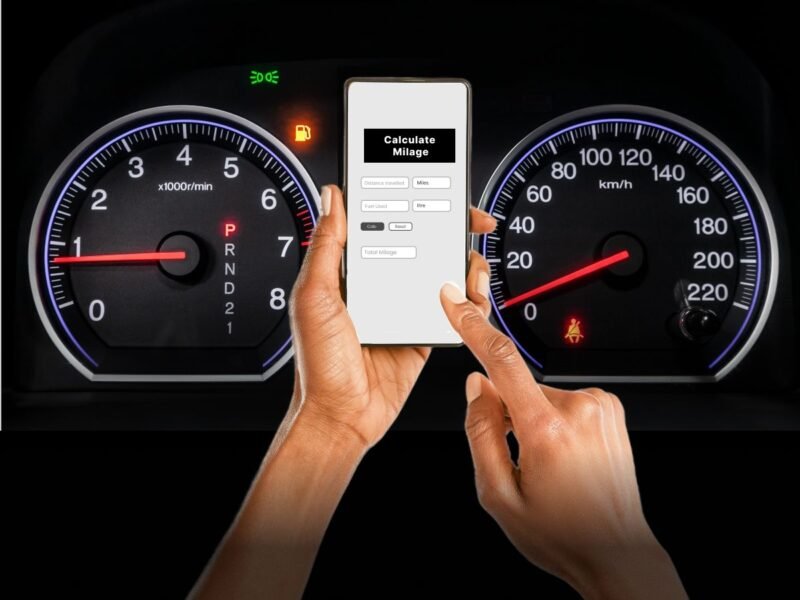
Knowing your car’s actual fuel efficiency can help you understand running costs, plan road trips and compare your vehicle’s performance with other cars. While manufacturers publish claimed mileage figures, real-world fuel efficiency can vary depending on traffic, driving style, road conditions, tyre pressure and vehicle load.
A mileage calculator makes this calculation easier. However, you can also calculate your car’s mileage manually using a simple formula.
What Is Car Mileage?
Car mileage refers to the distance a vehicle can travel using a specific amount of fuel.
In India, petrol and diesel car mileage is generally expressed as kilometres per litre (km/l).
For CNG vehicles, efficiency is commonly expressed as kilometres per kilogram (km/kg).
For example, if your petrol car travels 450 km using 30 litres of fuel, its mileage is:
450 ÷ 30 = 15 km/l
So, the car delivers approximately 15 km/l under those driving conditions.
How to Calculate Car Mileage
The basic mileage formula is:
Mileage = Distance Travelled ÷ Fuel Consumed
You need only two figures:
Distance travelled: The number of kilometres driven.
Fuel consumed: The number of litres of petrol or diesel used.
Example
Suppose you drive 600 km and use 40 litres of petrol.
600 ÷ 40 = 15 km/l
Your car’s calculated mileage is therefore 15 km/l.
You can use an online mileage calculator to perform the same calculation without doing it manually.
How to Calculate Real-World Mileage
The easiest way to calculate real-world mileage is the full-tank method.
First, fill your fuel tank completely and record the odometer reading or reset the trip meter.
Drive normally for several days or until you need to refuel.
At the next refill, fill the tank completely again and note how much fuel was added.
Then use:
Real-world mileage = Distance travelled ÷ Fuel added
Full-Tank Example
Suppose your starting odometer reading is:
20,000 km
At the next full refill, it shows:
20,480 km
The distance travelled is:
20,480 − 20,000 = 480 km
If you added 32 litres of petrol:
480 ÷ 32 = 15 km/l
Your real-world mileage for that period was approximately 15 km/l.
Repeating the calculation across several refuelling cycles can give you a more representative average.
How to Calculate Mileage Using a Trip Meter
Most modern cars have a trip meter that can be reset before starting a journey.
For example:
Trip meter at start = 0 km
Trip meter at refill = 350 km
Fuel added = 25 litres
Therefore:
350 ÷ 25 = 14 km/l
This method is particularly convenient when you want to monitor mileage over a specific period.
How a Mileage Calculator Helps
An online mileage calculator can simplify the calculation by automatically applying the formula.
Instead of manually dividing the distance by fuel consumption, you can enter the required figures and get the estimated mileage.
It can be useful when:
- Checking your car’s actual fuel efficiency
- Comparing different vehicles
- Estimating fuel requirements
- Planning road trips
- Tracking changes in mileage
- Calculating approximate running costs
How to Calculate Fuel Required for a Trip
Mileage can also be used to estimate how much fuel you will need for a journey.
The formula is:
Fuel Required = Distance ÷ Mileage
Suppose you are planning a 750 km trip and your car averages 15 km/l.
750 ÷ 15 = 50 litres
You would need approximately 50 litres of fuel under the assumed mileage.
Actual consumption may differ because real-world driving conditions can change throughout the journey.
How to Calculate Fuel Cost
Once you know the estimated fuel requirement, calculating the fuel cost is simple.
The formula is:
Fuel Cost = Fuel Required × Fuel Price
Suppose:
Trip distance = 750 km
Mileage = 15 km/l
Fuel price = ₹100/litre
Fuel required:
750 ÷ 15 = 50 litres
Estimated fuel cost:
50 × ₹100 = ₹5,000
Therefore, the estimated fuel expense is ₹5,000.
A mileage calculator can help with the first part of this calculation, while a fuel-cost calculation can then be used to estimate the total expense.
How to Calculate Monthly Fuel Expenses
You can also use your average mileage to estimate your monthly fuel budget.
Suppose you drive:
1,800 km per month
Your average mileage is:
15 km/l
Fuel required:
1,800 ÷ 15 = 120 litres
If petrol costs ₹100 per litre:
120 × ₹100 = ₹12,000
Your estimated monthly fuel expense would be ₹12,000.
If your mileage improves, the amount of fuel required for the same distance decreases.
Claimed Mileage vs Real-World Mileage
One of the most important things to understand when calculating car mileage is the difference between claimed and real-world efficiency.
Manufacturers publish fuel-efficiency figures measured under standardised testing conditions.
Your actual mileage can be different because of:
Traffic: Frequent stops and starts can increase fuel consumption.
Driving style: Hard acceleration and sudden braking can reduce efficiency.
Speed: Higher speeds can increase fuel consumption.
Vehicle load: Carrying additional weight can require more energy.
Air conditioning: AC usage can influence fuel consumption.
Tyre pressure: Incorrect tyre pressure can increase rolling resistance.
Road conditions: Hills, rough roads and congested routes can affect efficiency.
For this reason, your own fuel records can be more useful when estimating everyday mileage.
How to Calculate City Mileage
City mileage can be calculated using the same formula.
However, urban driving typically involves more stops, traffic lights, idling and acceleration.
For example:
Distance driven in city = 300 km
Fuel consumed = 25 litres
300 ÷ 25 = 12 km/l
The calculated city mileage is 12 km/l.
For a more accurate figure, calculate city mileage over several trips instead of relying on one short journey.
How to Calculate Highway Mileage
Highway mileage can also be calculated using the same formula.
For example:
Highway distance = 500 km
Fuel consumed = 30 litres
500 ÷ 30 = 16.67 km/l
The highway mileage is approximately 16.7 km/l.
A vehicle may deliver better highway efficiency than city efficiency because steady-speed driving generally involves fewer stops and starts.
However, high speeds can also increase fuel consumption.
How to Calculate CNG Car Mileage
CNG vehicle efficiency is generally measured in km/kg, rather than km/l.
The formula remains the same:
Mileage = Distance Travelled ÷ CNG Consumed
For example:
Distance = 400 km
CNG consumed = 25 kg
400 ÷ 25 = 16 km/kg
The calculated CNG efficiency is therefore 16 km/kg.
How to Calculate EV Efficiency
Electric vehicles don’t use petrol or diesel, so their efficiency is generally discussed using energy consumption rather than km/l.
EV efficiency may be expressed as:
km/kWh
or
kWh/100 km
For example, if an EV travels 300 km using 50 kWh:
300 ÷ 50 = 6 km/kWh
This provides an indication of how efficiently the vehicle uses electrical energy.
For EV buyers, battery capacity, charging efficiency, real-world range and electricity cost are more relevant than traditional fuel mileage.
How to Improve Car Mileage
If your vehicle’s mileage is lower than expected, several driving and maintenance practices may help improve fuel efficiency.
Maintain Correct Tyre Pressure
Check tyre pressure regularly and maintain the manufacturer’s recommended level.
Underinflated tyres can increase rolling resistance and require more energy to move the vehicle.
Drive Smoothly
Avoid unnecessary hard acceleration and sudden braking.
Smooth acceleration and maintaining a consistent speed can help reduce fuel consumption.
Avoid Excessive Idling
Leaving the engine running while parked or waiting consumes fuel without increasing the distance travelled.
Reduce Unnecessary Weight
Remove heavy items from the boot or cabin that you don’t regularly need.
A heavier vehicle requires more energy to accelerate and move.
Maintain the Vehicle
Follow the manufacturer’s service schedule.
Poorly maintained mechanical components can affect vehicle efficiency and performance.
Use the Correct Fuel
Always use the fuel type recommended by the manufacturer.
If your vehicle has specific fuel requirements, follow the manufacturer’s instructions rather than assuming a different fuel will improve mileage.
Why Has My Car Mileage Suddenly Dropped?
A noticeable reduction in mileage can happen for many reasons.
Possible factors include changes in traffic conditions, driving habits, tyre pressure, vehicle load, weather, air-conditioning usage or maintenance condition.
If the reduction is persistent or accompanied by warning lights, unusual noises, poor performance or other symptoms, have the vehicle inspected by a qualified technician.
Don’t assume that every mileage drop is caused by driving style.
How Often Should You Calculate Your Car Mileage?
There is no need to calculate mileage after every short trip.
A practical approach is to calculate it after several refuelling cycles.
This reduces the effect of unusual traffic, a particularly short journey or temporary driving conditions.
For example, you can record:
Date → Odometer → Fuel added → Fuel price → Calculated mileage
Over time, this creates a useful record of your vehicle’s fuel efficiency.
Mileage Calculation for a Used Car
If you’re buying a used car, mileage can be an important factor, but don’t judge the vehicle solely by its claimed fuel efficiency.
Check:
- Actual kilometres driven
- Service history
- Tyre condition
- Engine performance
- Maintenance records
- Previous usage
- Accident history
A well-maintained higher-mileage car can sometimes be a more practical purchase than a poorly maintained vehicle with a lower odometer reading.
Frequently Asked Questions
What is the formula for calculating car mileage?
The basic formula is:
Mileage = Distance Travelled ÷ Fuel Consumed
For example, 500 km divided by 35 litres gives approximately 14.3 km/l.
How can I calculate my car’s real mileage?
Fill the tank completely, record the odometer or reset the trip meter, drive normally, refill the tank completely and divide the distance travelled by the amount of fuel added.
Is a mileage calculator accurate?
A mileage calculator accurately performs the calculation based on the figures you enter. The accuracy of the final mileage figure depends on how accurately you measure the distance and fuel consumed.
Why is my actual mileage lower than the claimed mileage?
Claimed mileage is measured under standardised test conditions. Real-world efficiency can vary because of traffic, driving style, speed, road conditions, vehicle load, tyre pressure and other factors.
How can I calculate fuel cost from mileage?
First calculate the fuel required:
Fuel Required = Distance ÷ Mileage
Then calculate:
Fuel Cost = Fuel Required × Fuel Price
Does driving speed affect mileage?
Yes. Fuel consumption can increase at higher speeds because aerodynamic resistance increases. The most efficient speed can vary between vehicles and driving conditions.
How do I calculate CNG mileage?
Divide the distance travelled by the amount of CNG consumed in kilograms.
CNG Mileage = Distance ÷ CNG Consumed
Can I calculate EV mileage using km/l?
No. Electric cars don’t consume petrol or diesel. Their efficiency is generally measured using units such as km/kWh or kWh/100 km.
Final Thoughts
Calculating your car’s mileage is one of the simplest ways to understand its running efficiency. The basic formula is straightforward:
Mileage = Distance Travelled ÷ Fuel Consumed
For regular monitoring, the full-tank method can provide a useful estimate of real-world fuel efficiency. An online mileage calculator can make the calculation quicker and can also help when estimating fuel requirements for a trip.
Remember that mileage isn’t a fixed number. Traffic, driving habits, vehicle condition, tyre pressure, road conditions and load can all influence the result.
If you want to monitor your car accurately, calculate its mileage across several refuelling cycles and use the average rather than relying on a single reading.