

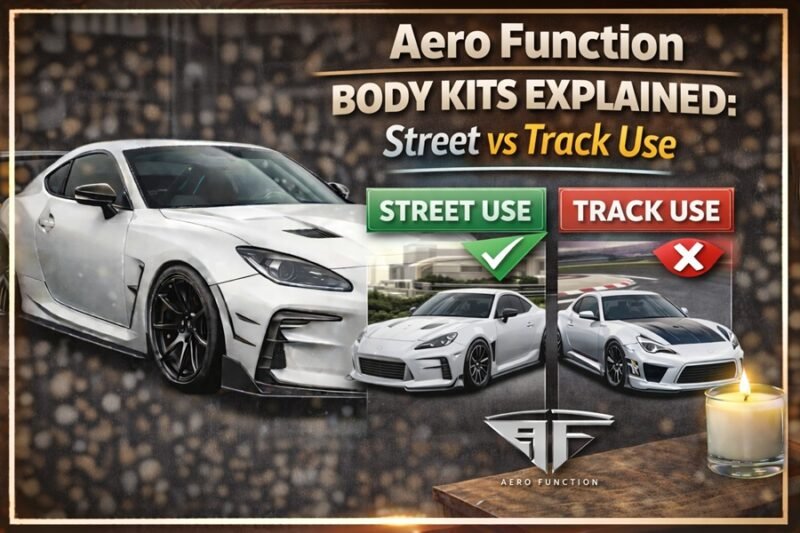
Aero Function Body Kits Explained: Street vs Track Use
When you transition from entry-level aesthetics to high-end performance tuning, the names on your parts list change. You move away from “budget-friendly” fiberglass and toward brands that prioritize aerodynamic efficiency and material integrity.
Aero Function body kits occupy a unique space in the aftermarket industry. Positioned as a premium solution for luxury and exotic platforms—ranging from Porsche and BMW to Land Rover—Aero Function claims to bridge the gap between “Street Style” and “Track Function.”
But does the hardware live up to the marketing? In this guide, we break down the materials, the wind-tunnel-inspired designs, and how these kits handle daily driving versus high-speed circuits.
1. Material Science: GFK vs. Carbon Fiber
The “Expertise” in Aero Function lies in their proprietary material blends. Unlike standard FRP (Fiberglass Reinforced Plastic), Aero Function utilizes two primary high-end composites:
Carbon Fiber (CF)
Aero Function uses a 3K Twill Weave carbon fiber. This isn’t just a wrap; it’s a structural component finished with a high-gloss, UV-protected clear coat.
-
Best For: Weight reduction and high-end “Show and Shine” appeal.
-
Track Benefit: Incredible rigidity under high downforce loads.
GFK (Glass Fiber Composite)
GFK is Aero Function’s answer to traditional fiberglass. It is a polymer-reinforced material that is denser and more heat-resistant than standard kits.
-
Best For: Daily drivers and street builds.
-
Track Benefit: Unlike brittle fiberglass, GFK has a higher “shear strength,” meaning it can withstand the vibrations of a stiff track suspension without immediate stress cracking.
2. Street Use: Aesthetics and Durability
For the street enthusiast, an Aero Function body kit is a statement of “OEM Plus” styling. They avoid the “boy racer” look in favor of sophisticated, wide-arched silhouettes.
The Reality of Daily Driving:
-
Ground Clearance: Aero Function front lip spoilers are designed with a specific rake. While they look low, many designs incorporate a “swept-back” underside to help clear standard speed bumps.
-
The “UV” Factor: One of the biggest complaints with cheap carbon fiber is yellowing. Aero Function uses marine-grade UV inhibitors in their resin, ensuring the kit doesn’t look aged after one summer in the sun.
-
Fitment: These kits are handmade. While the fitment is significantly better than “no-name” eBay kits, they still require professional installation to ensure the panel gaps match the precision of a luxury vehicle.
3. Track Use: Aerodynamics and Weight
This is where the “Function” in the brand name is tested. On a race track, a body kit is no longer a decoration—it is a tool to manage airflow.
| Track Component | Function | Performance Gain |
| Front Splitter | High-Pressure Zone | Increases front-end “bite” and reduces understeer in fast corners. |
| Side Skirts | Airflow Management | Prevents high-pressure air from “leaking” under the chassis. |
| Rear Diffuser | Venturi Effect | Accelerates under-car airflow to create a vacuum (downforce). |
Authoritative Note: If you are tracking a car with Aero Function parts, we recommend reinforced mounting points. The downforce generated at $120\text{ mph}$ ($193\text{ km/h}$) can put hundreds of pounds of pressure on a front lip; simple plastic clips won’t suffice.
4. The “Street vs. Track” Comparison
| Feature | Street Priority | Track Priority |
| Primary Goal | Visual Impact & Resale Value | Lap Times & Cooling Efficiency |
| Material Choice | GFK (for easy repair/paint) | Carbon Fiber (for weight/rigidity) |
| Installation | Visual alignment/Seamless gaps | Structural mounting/Bolted to frame |
| Maintenance | Waxing & Ceramic Coating | Inspection for stress fractures |
5. Is Aero Function Worth the Premium?
Aero Function kits are an investment. They sit at a higher price point because they target vehicles where a “cheap” kit would actually devalue the car.
You should choose Aero Function if: 1. You own a luxury or exotic platform.
2. You want a kit that provides actual aerodynamic data/design rather than just “looking cool.”
3. You prefer the look of high-gloss, authentic carbon fiber.
You should reconsider if:
-
You are on a strict budget (the prep and paint for GFK can be expensive).
-
You are looking for “bash-bar” style drift aero (KBD might be a better choice for high-impact use).