
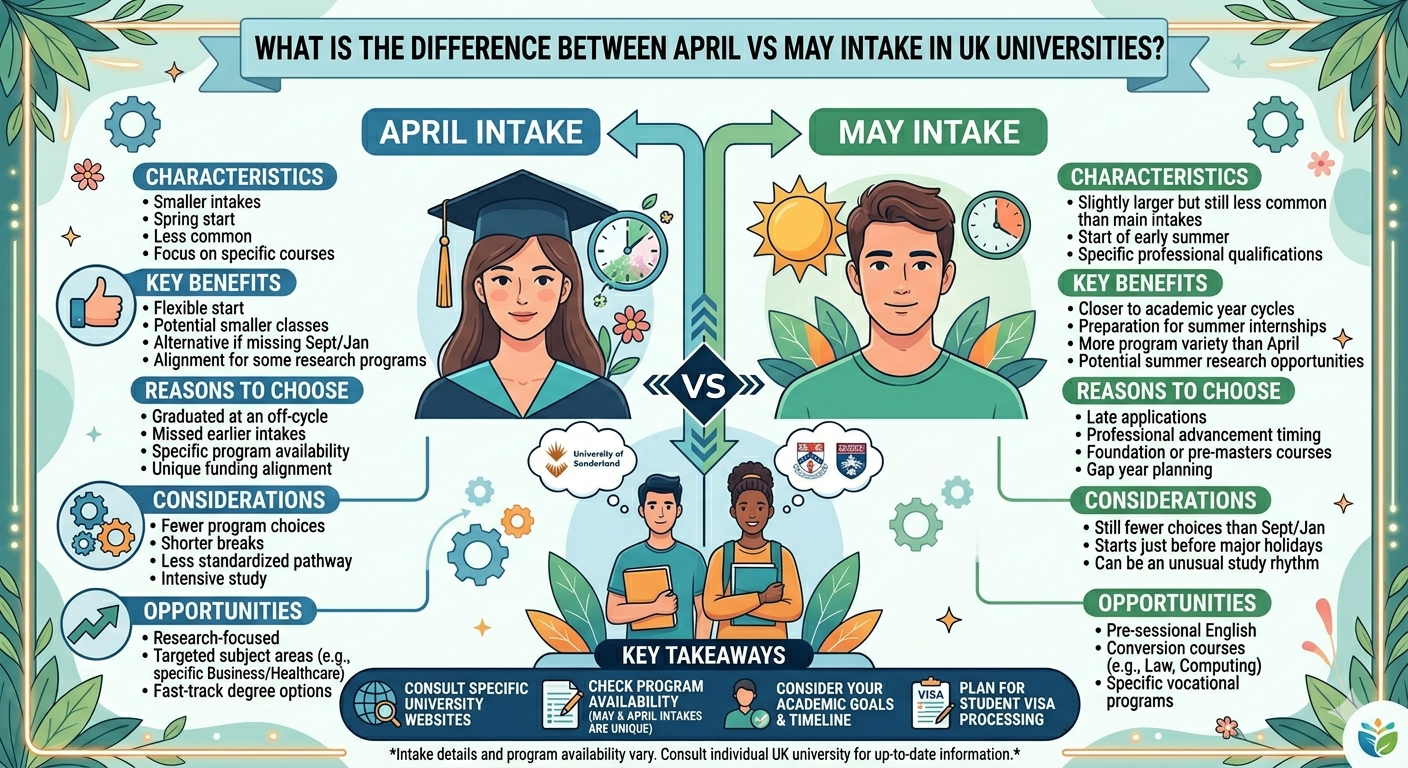
What is the difference between April vs May intake in UK universities?
I get asked this question every year. A student misses the January deadline. They panic. They start looking for the next available intake. They see April and May mentioned on university websites. And they assume these are two separate cycles with the same options.
They are not. April and May are very similar. Both are late spring intakes. Both have limited courses. Both are quieter than September or January. But there are subtle differences that matter for your planning.
Let me break it down so you know what you are getting into.
Both are secondary intakes, not main ones
First, understand where these fit in the hierarchy. September is the main intake. Almost every course is open. Scholarships are available. Freshers’ week is happening. Campus is full of energy.
January is the second intake. Fewer courses. Quieter campus. But still a solid option. Many students use it as a backup for September.
April and May are the third tier. They are late spring intakes. Very few universities offer them. Very few courses. They exist for specific programs and specific students who cannot wait until September.
If you are planning your UK journey, aim for September. January is your backup. April and May are for niche situations only.
The main difference is timing, not content
April and May intakes are not fundamentally different. The course content is the same. The degree you graduate with is the same. The post-study work visa eligibility is the same.
The difference is simply when you start. April intake begins in early to mid-April. May intake begins in early to mid-May. That is a four to six week gap.
For most students, that gap does not matter much. But for some, it makes a real difference. If you are waiting for exam results. If you need extra time for your visa. If you want to avoid the April heat in India. Those few weeks can be valuable.
Which universities offer these intakes
Not many. The ones that do are usually newer universities or those with flexible business programs. University of Bedfordshire. University of East London. University of Northampton. University of Sunderland. Teesside University. Some others.
Russell Group universities almost never have April or May intake. Do not expect to start at Oxford, Cambridge, Imperial, Manchester, or Edinburgh in April or May. It will not happen.
The courses offered in these intakes are typically business and management. MBA. International business. Marketing. Project management. Supply chain. Some computing courses. You will not find engineering, healthcare, law, or sciences.
So if your course is specialized, April and May are likely not options for you.
April intake 2026: the earlier spring option
For April intake in UK 2026, applications usually open around August to September 2025. Deadlines are typically November to December 2025. That is earlier than most students realise. You cannot decide in February and start in April.
The visa timeline is tight. You need your CAS from the university by January or February 2026. Then your visa appointment. Then processing time. If anything goes wrong, you miss the intake entirely.
The advantage of April is that you finish earlier. If you start a one-year master’s in April 2026, you finish around April 2027. You can then start your graduate visa and job search in the spring. Some students prefer this timeline over finishing in September or January.
May intake 2026: the later spring option
For May intake in UK 2026, applications open around September to October 2025. Deadlines are typically December 2025 to January 2026. Slightly later than April, but still early.
The visa timeline is similarly tight. You need your CAS by February or March 2026.
The advantage of May is that you have a few extra weeks to prepare. If your visa was delayed for April, May gives you a second chance. If your exam results come out in April, May works better.
The disadvantage is that you finish later. May 2026 start means May 2027 finish. Your graduate visa then runs until May 2029. That is fine. Just different.
The student experience is quiet for both
April and May are not busy times on UK campuses. Freshers’ week does not happen. Student societies are less active. Many students are finishing exams or going home for the summer.
You will not get the traditional UK university experience. If you want clubs, events, and crowded common rooms, wait for September.
But some students do not care about this. They want the degree and the visa. They are focused on studying, not socializing. For them, quiet is fine.
Accommodation is harder for both
Most student housing contracts run from September to August. Finding a room starting in April or May is difficult. You may end up in temporary housing, an Airbnb, or a sublet from a student leaving early.
Plan ahead. Start looking for accommodation months before you arrive. Join Facebook groups for students at your university. Ask the international office for recommendations.
Some universities have partnerships with private accommodation providers that offer flexible start dates. Ask your admissions contact about this before you accept your offer.
Scholarships are rare for both
Universities allocate most of their scholarship budget to September intake. January gets some leftovers. April and May get almost nothing.
Do not expect a large scholarship for a late spring intake. The best you can hope for is a small automatic discount. If you need significant financial aid, wait for September.
Who should choose April or May intake
These intakes are not for everyone. But they work well for specific situations.
You should consider April or May if you have an urgent timeline and cannot wait until September. If your course is offered in that intake. If you already have all your documents ready. If your English test is done. If your funds are in place. If you do not care about campus life or freshers’ week. If you just want to start and finish as quickly as possible.
Who should avoid April and May intakes
You should avoid these intakes if you want a wide choice of courses. If you need a scholarship. If you want the full UK university experience. If your course is not offered in spring. If you can wait until September.
For the vast majority of students, September is better. January is acceptable. April and May are distant thirds.
The bottom line
The difference between April and May intake is mostly about timing. Four to six weeks. That matters for visa planning, accommodation, and completion dates. But the course content, degree recognition, and post-study work rights are identical.
Both are limited. Few universities. Few courses. Mostly business. Quiet campuses. Harder accommodation. Rare scholarships. Tight deadlines.
Only consider April intake in UK 2026 if you are fully prepared and cannot wait. Only consider May intake in UK 2026 if you missed April and still cannot wait until September.
For everyone else, do not rush. Wait for September. A few months of patience is better than a rushed start in the wrong intake. Choose wisely.